

A hallway is the one place in a house where a gallery wall genuinely belongs. You move past it, so the artwork is read in sequence rather than all at once — and a sequence wants rhythm, not variety.
The simplest version, and the one that almost always works, is three prints of the same size, evenly spaced, at one shared centre line.
Plan the run before you hang anything
Measure the usable wall, subtract 30 cm at each end, then divide what remains between the frames and the gaps. For three prints of 40 cm wide, allow 8–10 cm between frames; the gap should always be smaller than the narrowest frame so the group reads as one object.
Mark the centre line at 150 cm and keep every frame on it, regardless of whether the prints are portrait or landscape. A consistent centre line is what separates a considered run from a scattering.
Stairs: follow the pitch, not the steps
On a staircase, set an imaginary line parallel to the handrail and hang each frame with its centre on that line, spaced as evenly as the treads allow. The eye accepts the diagonal instantly because it matches your own movement upward.
Keep the frames identical on a stair. Mixed sizes climbing a diagonal look accidental.
Choose a theme the run can carry
A hallway is where a body of work makes sense: three French churches; three Atlantic landscapes from the same island; three studies of the same coastline in different weather. The repeated subject is what makes the corridor feel curated.
Because you view them close and briefly, hallway prints can carry more detail than living room pieces — pencil construction lines and small notation read well at arm's length.
Light and practicalities
Hallways are usually dim, so matte paper is again the right choice: it holds tone under low, direct downlights that would blow out a glossy surface. If the corridor has a single wall light, hang the run on the opposite wall to avoid a hotspot.
Narrow frames also matter here for a physical reason — a deep moulding in a tight corridor catches shoulders and coats.
Prints to start with
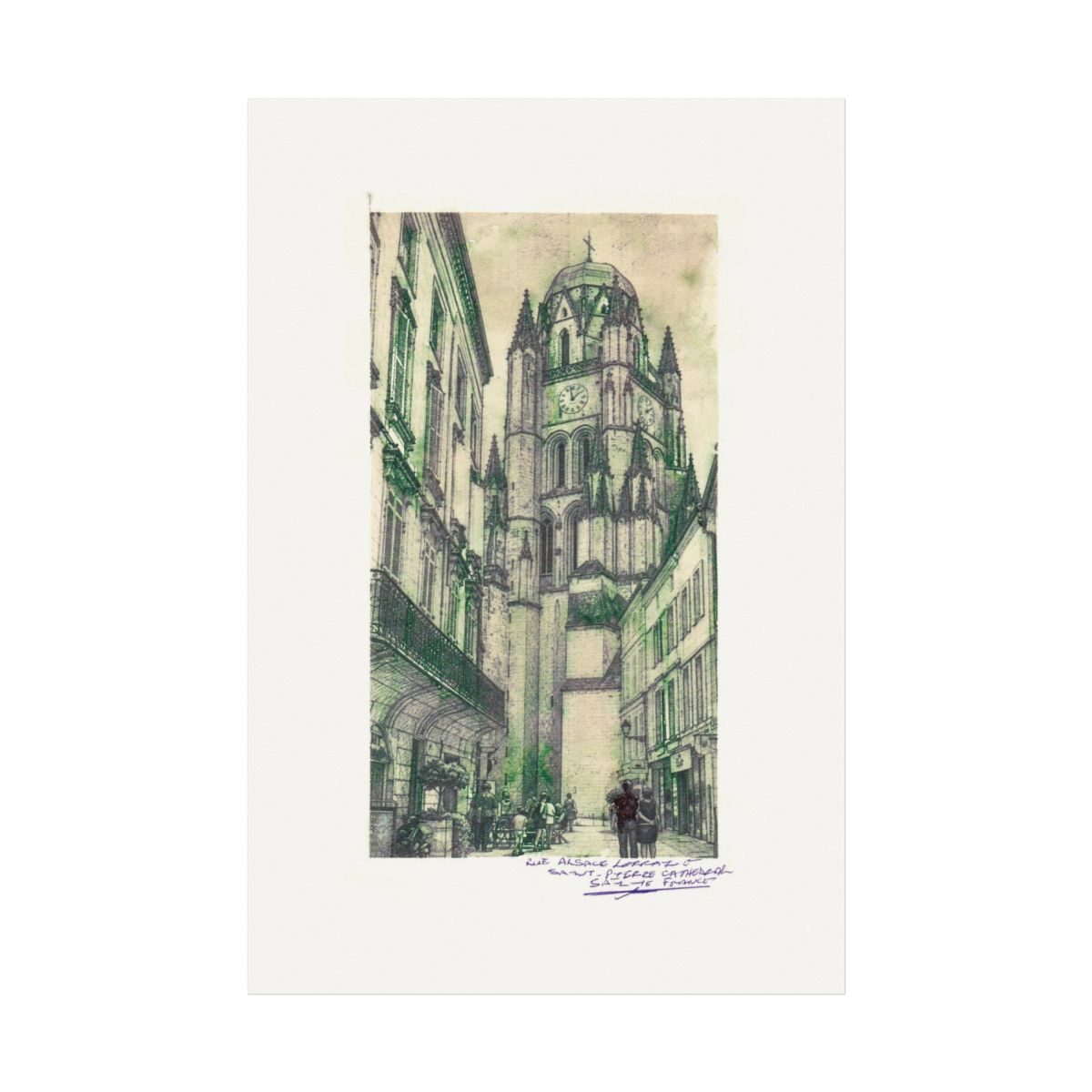
Cathédrale Saint-Pierre, Saintes
Ink and watercolour on paper · Saintes, France
The great flamboyant tower of Saint-Pierre seen from the street below, drawn in warm ochre wash with two figures left in to give the stonework its true scale.
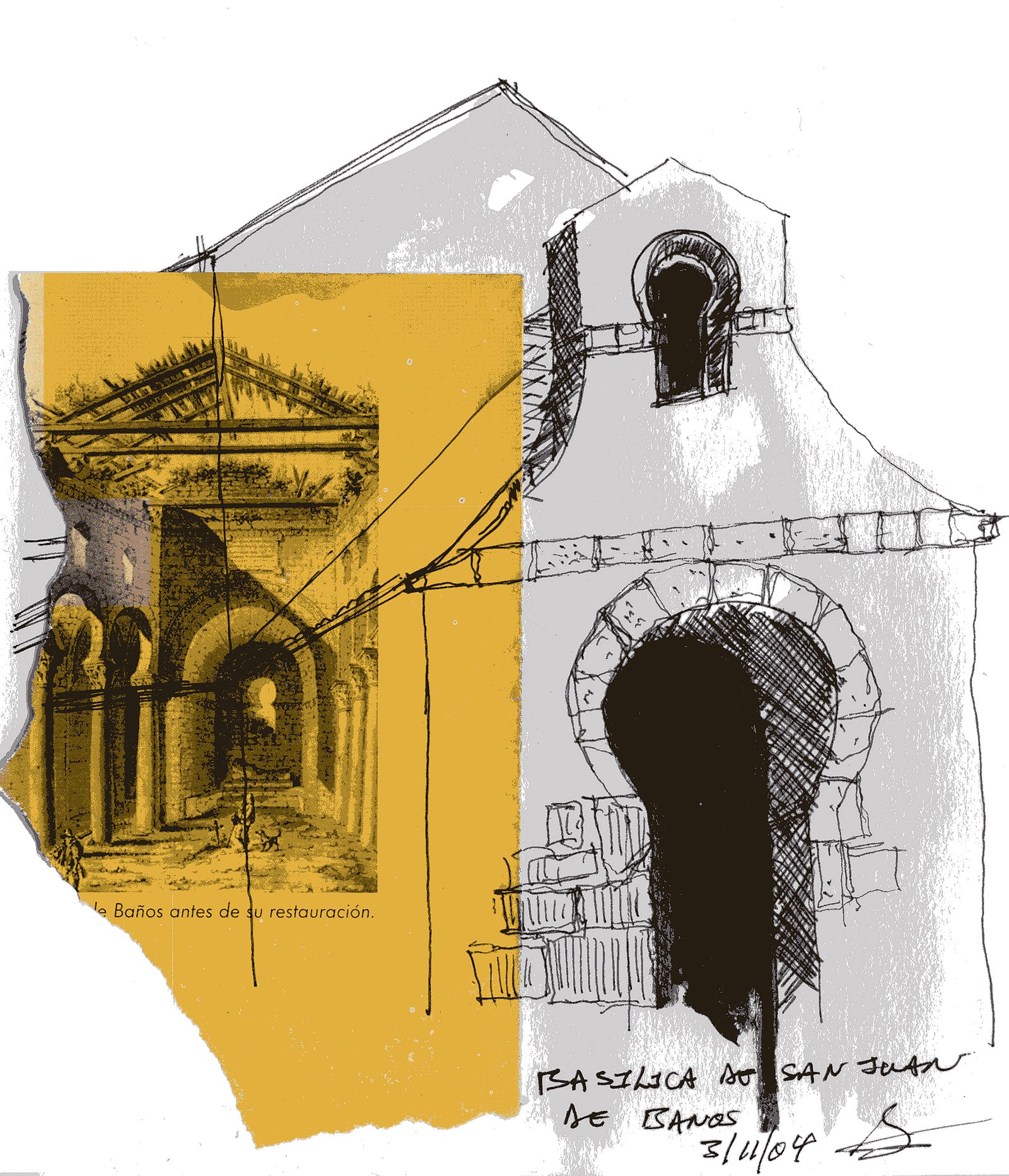
Church of San Juan Bautista de Baños
Collage and ink · Baños de Cerrato, Spain
One of the oldest churches on the Iberian peninsula, rebuilt in paper. Torn ochre fragments stand in for the Castilian plain while the horseshoe arch is left as clean drawing.
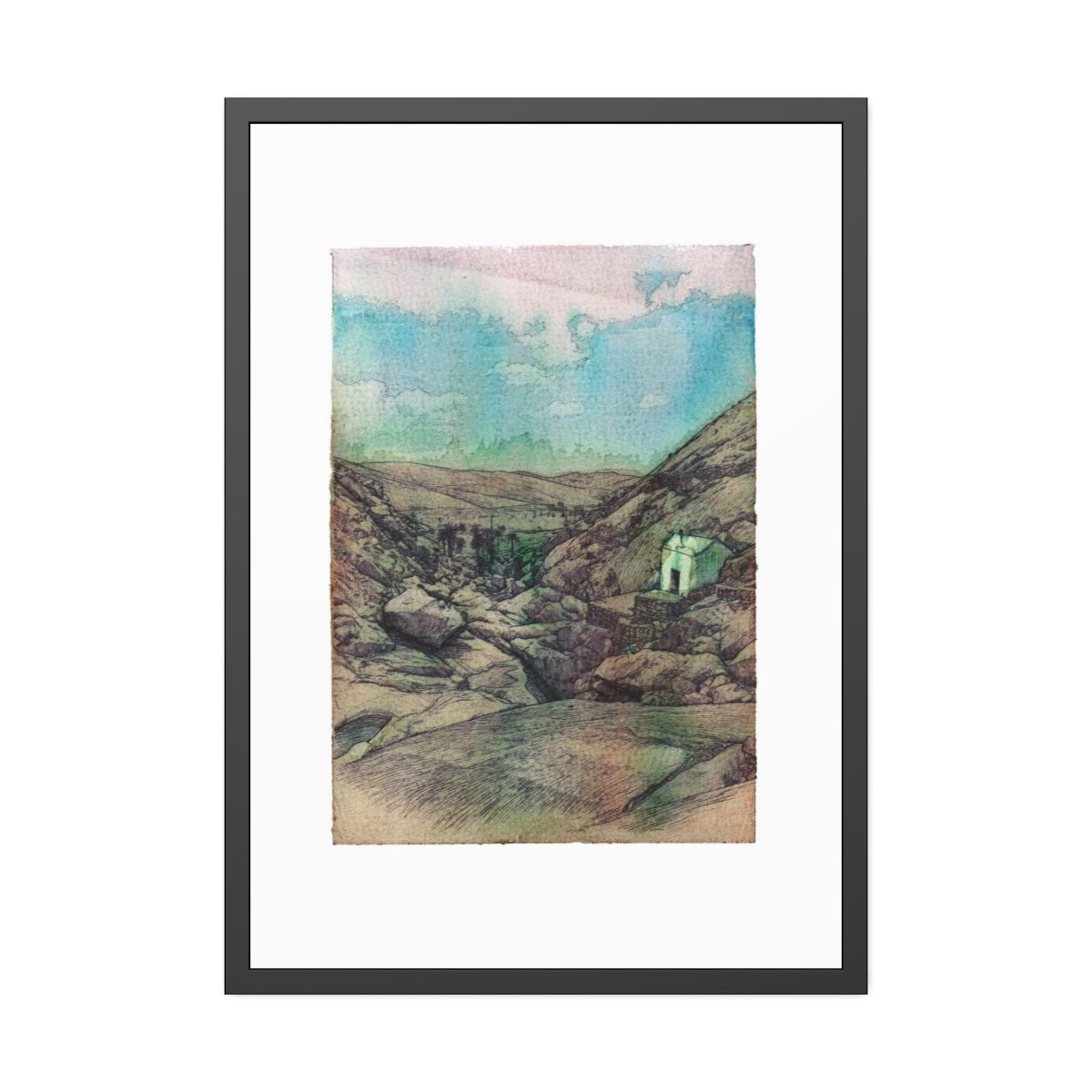
Mystical Chapel in a Mountainous Landscape
Ink and watercolour on paper · Fuerteventura, Canary Islands
A small white ermita almost lost among folded hills, drawn in soft ochre, green and rose. The building is the smallest thing in the picture and the reason for it.
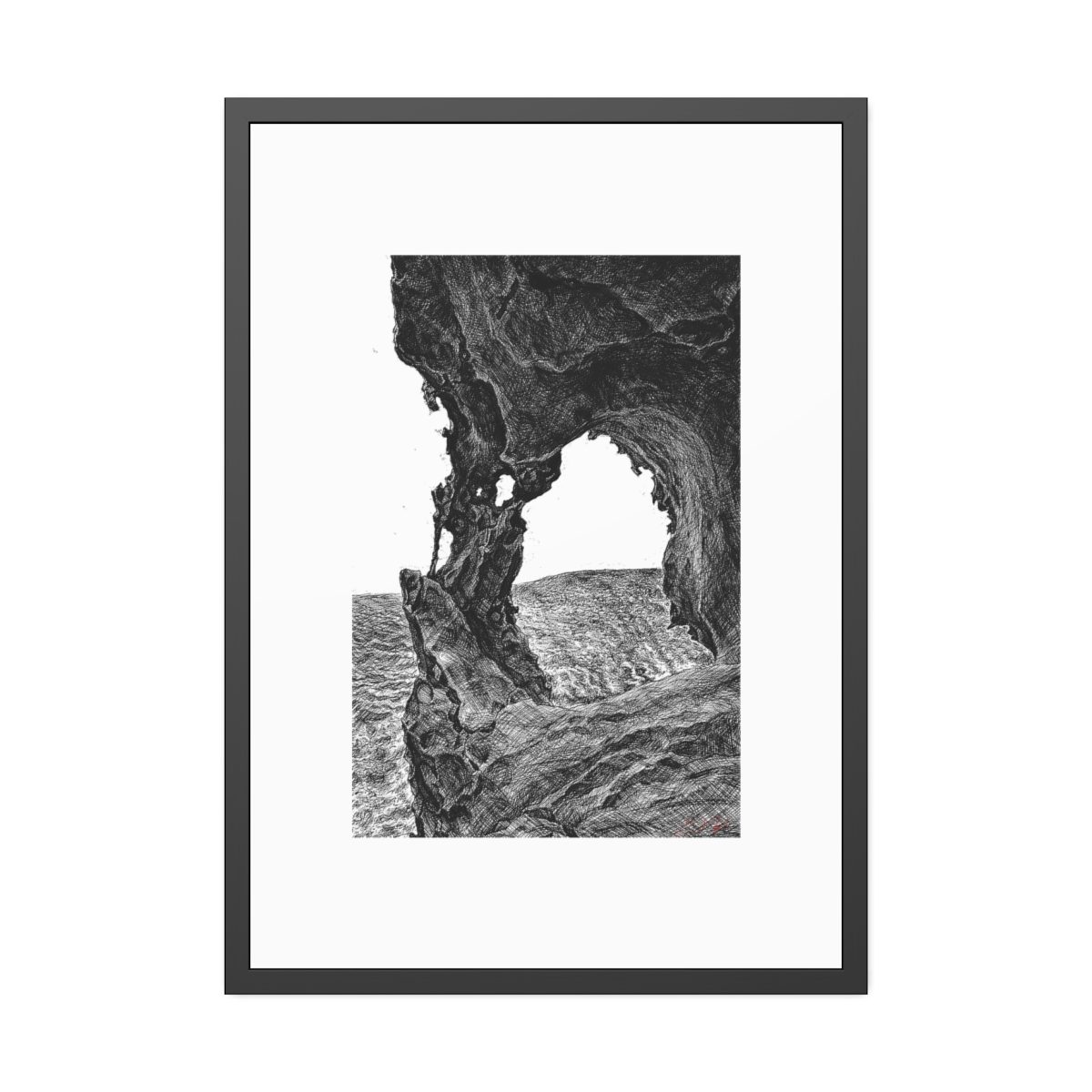
Erosion Gate
Pen and ink on paper · Fuerteventura, Canary Islands
A hollowed volcanic gateway on the north coast, drawn looking through it rather than at it — the rock as doorway, with the shoreline running out beyond.


Questions buyers ask
- How many prints should a hallway have?
- Three is the reliable number for a typical corridor wall — enough to read as a sequence, few enough to keep the spacing generous. Four or five suits a long hall.
- How far apart should the frames be?
- Between 8 and 12 cm for prints up to about 50 cm wide. Keep the gap narrower than the frames themselves so the run reads as one group.
- How do I hang art up a staircase?
- Set a line parallel to the handrail, keep every frame the same size, and centre each one on that line with even horizontal spacing.
- Should hallway prints match?
- Match the size and framing; vary the image. A shared subject — one region, one building type, one coastline — is what makes the run feel deliberate.
- Can I order a matching set of three?
- Yes. Choose three drawings and order them in the same size from the shop so the framing and spacing stay consistent.
Full terms are on the shipping policy and refund & returns pages.
Build a hallway set
Browse the complete artwork archive or the collections. Every drawing is available as a made-to-order print from the GAK Creations shop, with sizes, paper and framing options shown at checkout.
Shop prints for a run