

An architectural drawing behaves differently on a wall than a photograph or an abstract does. It is mostly white paper. It has one dense area of line work and a great deal of quiet around it, and that quiet is the reason it settles a room rather than shouting at it. Hung well, a single building study can hold a whole wall; hung badly — too small, too high, too tightly framed — the same sheet disappears.
Start with the wall, not the picture
Before choosing an image, measure the space it will live in and decide what the artwork is answering to: a sofa, a bed, a stairwell, a long hallway. Art hung above furniture should span roughly two thirds of the furniture's width. On an empty wall, the artwork should occupy about sixty per cent of the visual field between the skirting and the ceiling line.
Those two rules alone settle most decisions. A three-seat sofa wants one print near 70–100 cm wide, or a pair of narrower prints read as a single block. A narrow hallway wants a run of small, evenly spaced sheets at a consistent centre height, which turns the corridor into a gallery rather than a corridor with pictures in it.
Match the drawing to the light
High-contrast architectural studies — dense ink, strong shadow lines, a Romanesque façade with deep reveals — hold up in raking, directional daylight. Put them on the wall the sun crosses, where the shifting light plays against the drawn shadow.
Soft-wash pieces are the opposite. Granulating watercolour, pale stone and open sky need even, indirect light to keep their subtlety; strong sun bleaches them flat. North-facing rooms, landings and studies suit them best. If a room has both conditions, use the contrast deliberately: the stronger drawing on the lit wall, the quieter one opposite.
Frame it the way a drawing wants to be framed
A narrow profile in natural oak, matte black or off-white, and a mount of 5–7 cm. The mount is not decoration; it is the pause between the drawing and the room. Architectural work is made of thin lines, and thin lines need space or they read as noise from three metres away.
Use non-reflective or UV glazing in bright rooms. Keep the mount off-white rather than bright white so it agrees with the warm tone of the fine art paper, and let a slim margin of the printed sheet show if you want the print to read as a work on paper rather than a poster.
Pairs, sets and the argument between them
Two prints hung together should have a reason to be together. A Romanesque abbey beside the titanium curve of the Guggenheim in Bilbao makes an argument about nine centuries of building, and that argument is what a guest actually reads. A church on the Castilian plain beside a chapel above the Atlantic makes a quieter one about latitude and light.
For a set of three or more, keep one variable constant — same medium, same palette, or same subject family — and let the other vary. Hang them with equal gaps and a shared centre line; irregular spacing reads as an accident, not a decision.
Paper, ink and what "museum-grade" means
Every print in this archive is produced on heavyweight matte fine art stock with pigment inks. Matte matters for drawings: gloss throws glare across exactly the fine graphite and pen work you bought the piece for. Pigment matters for longevity — it resists fading far better than dye ink, which is why it is the standard for gallery editions.
Prints are made to order rather than warehoused, produced at the facility closest to the delivery address, and shipped worldwide. Nothing sits in stock fading in a box.
Where to begin in the archive
If you want structure and line, start with the Architecture collection. If you want colour and horizon, the Coastal collection and the Fuerteventura collection carry Atlantic light. For the reasoning behind the marks themselves, read When Architecture Becomes Art.
Three prints to start a wall
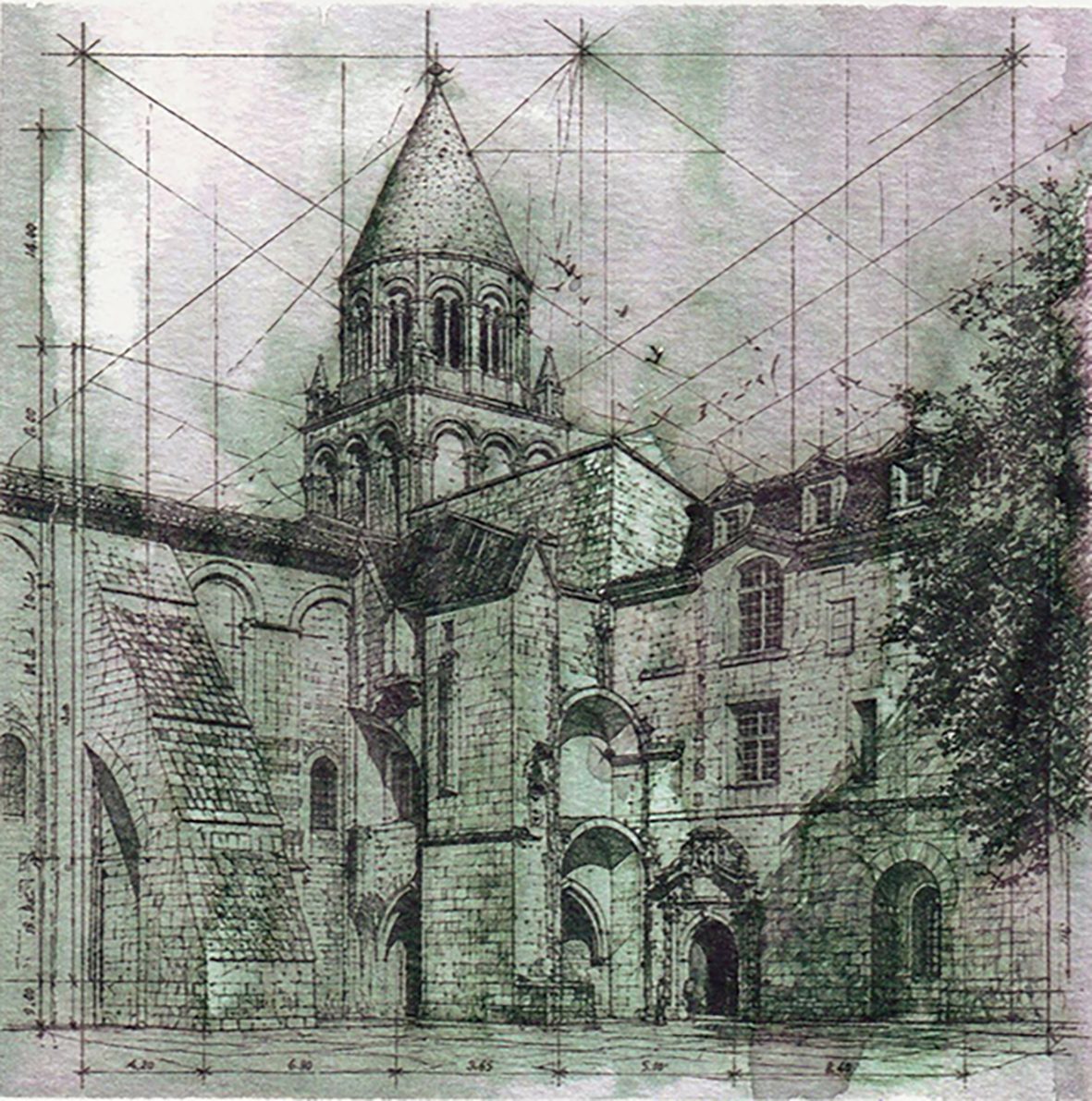
Abbaye aux Dames, Saintes
A Romanesque abbey in south-west France, drawn from the square in a single morning. The tiered bell tower is set out with the construction lines still showing, while diluted ink carries the shadow down the west front. A restrained, architectural print for a study, hallway or reading room.
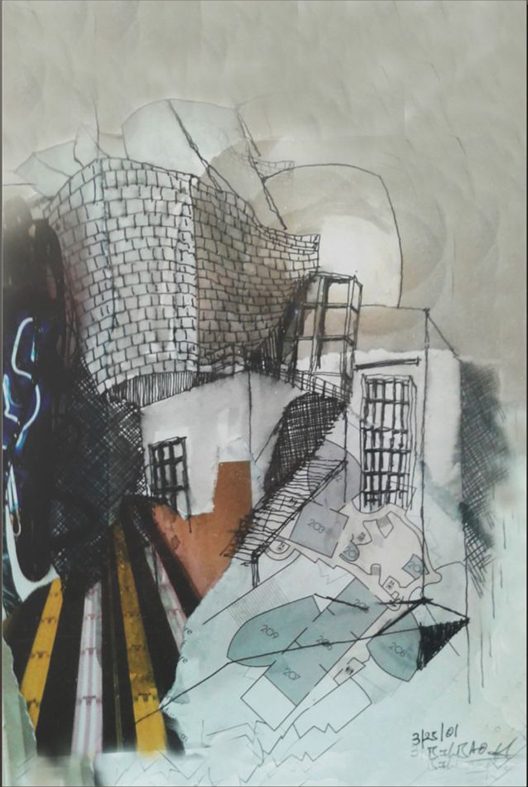
Guggenheim Museum Bilbao
Gehry's titanium curves rendered in torn metallic paper and ink, so the surface of the print behaves the way the building behaves in Basque light — reflective one moment, matte the next. A contemporary architectural collage print for modern interiors.
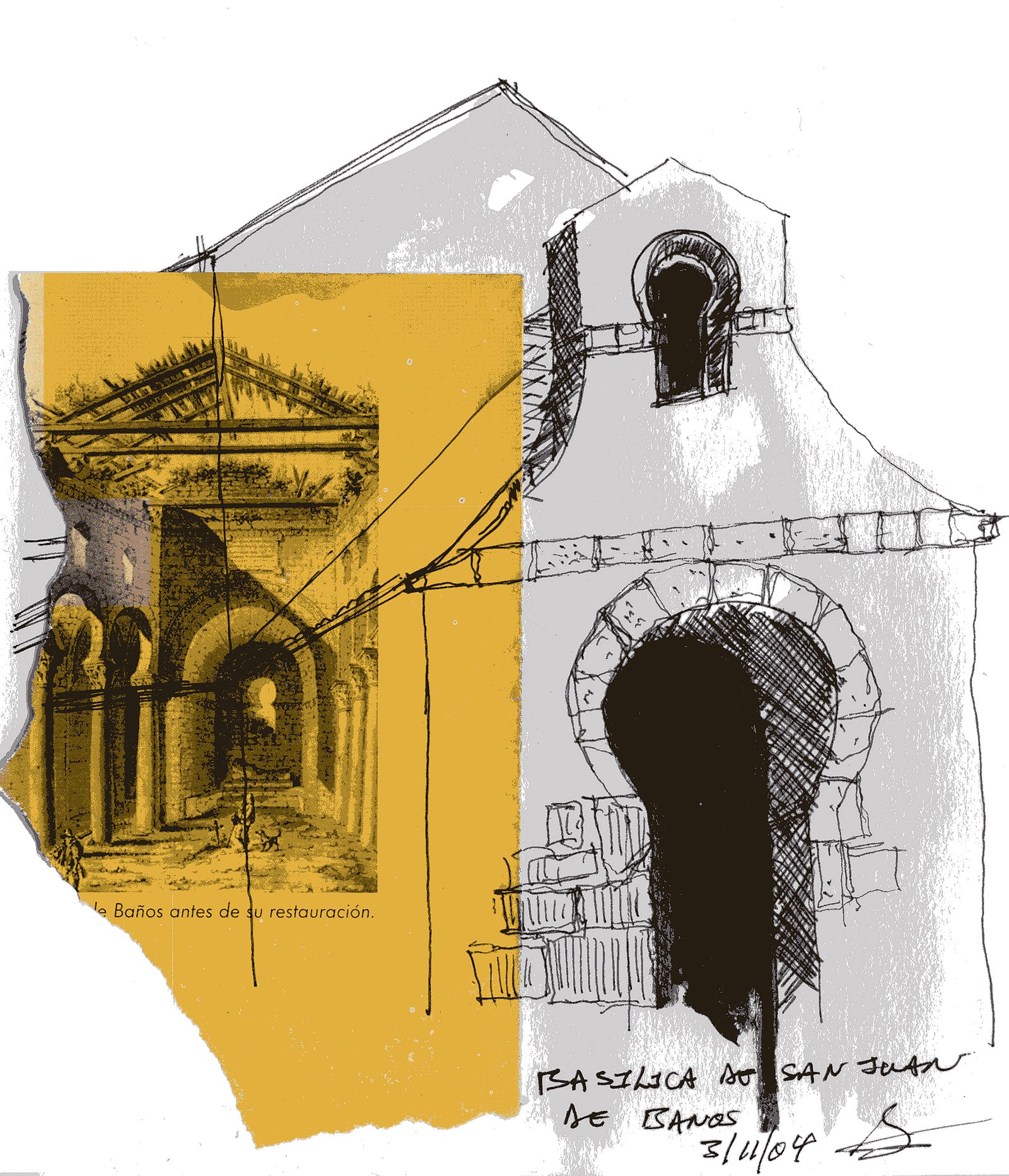
Church of San Juan Bautista de Baños
One of the oldest churches on the Iberian peninsula, drawn as a collage of ochre paper fragments and sketch line. The horseshoe arch is left as pure drawing while the surrounding plain is built from layered paper.


Questions buyers ask
- What size architectural art print should I buy?
- Measure the wall, then aim for artwork that fills roughly two thirds of the width of the furniture below it. Above a standard three-seat sofa that usually means one print of about 70–100 cm wide, or a pair of 40–50 cm prints hung with a hand's width between them. Architectural drawings carry fine construction lines, so err larger — detail that reads beautifully at 70 cm can disappear at 30 cm.
- How high should art be hung?
- Centre the image at about 145–150 cm from the floor, which puts the middle of the picture at average eye level. Over a sofa or sideboard, drop that so there is roughly 20–25 cm of clear wall between the top of the furniture and the bottom of the frame.
- What frame suits an architectural drawing?
- A narrow frame in natural oak, black, or white, with a generous off-white mount of 5–7 cm. The mount is doing the real work: it gives the drawing air and stops the wall crowding the line work. Avoid ornate mouldings — they compete with the geometry in the drawing.
- Will the print fade in a sunny room?
- The prints are made with pigment inks on museum-grade matte paper, which is far more stable than dye-based printing. Even so, no work on paper enjoys hours of direct midday sun. Hang across from a window rather than in the beam, and use glazing with UV protection in very bright rooms.
- Do you ship worldwide, and how long does it take?
- Yes. Every print is made to order and dispatched from the production partner nearest you, so most orders are produced in two to five business days and delivered within roughly one to two weeks. Full details are on the shipping policy page.
- What if the print arrives damaged or is not what I expected?
- Damaged or misprinted items are replaced or refunded — send a photo within 30 days of delivery and it is dealt with directly. The refund and returns policy sets out the process in full.
Full terms are on the shipping policy and refund & returns pages.
Browse the prints
Every drawing in the archive is available as a made-to-order print through the GAK Creations shop, with sizes, paper options and worldwide delivery shown at checkout.
Shop the prints